Okra, from seed to supper.
How to grow okra in a UK greenhouse or a warm-climate garden; when to pick the pods (young!); how to spot red spider mite, whitefly and aphids; and okra’s long story across Africa, South Asia and the American South. Every fact is checked against the RHS, Kew, Britannica, the FAO and US university extension services, and where they disagree we show each one.
The short version
Okra’s botanical name is Abelmoschus esculentus. It is a hairy annual of the mallow family (Malvaceae), grown for its edible fruit, the pod. Encyclopaedia Britannica: okra Okra is also known as ladies’ fingers or bhindi. RHS: How to grow okra
Okra needs plenty of heat and sun, so in the UK it usually has to be grown in a greenhouse or polytunnel, although plants may also fruit outdoors on a hot, sunny patio in a long summer. RHS: How to grow okra Clemson Extension calls okra a warm-season crop, grown throughout South Carolina. It grows best between 75°F and 90°F (about 24–32°C). Clemson Cooperative Extension, Home & Garden Information Center: Okra (HGIC 1313; written for South Carolina)
The RHS says pick pods while tender and immature, about 5–10cm (2–4in) long: large mature pods become tough and stringy. RHS: How to grow okra Okra grows very quickly, so Clemson says pick at least every two days. Pods left to mature on the plant hold back new pods. Clemson Cooperative Extension, Home & Garden Information Center: Okra (HGIC 1313; written for South Carolina)
Kew: the exact origin of okra is unknown, but it is thought to have come from Africa, where it has been grown as a crop for centuries. Royal Botanic Gardens, Kew: Plants of the World Online, Abelmoschus esculentus, species profile (Internet Archive copy of 4 June 2026) Okra is grown across the tropics, subtropics and warmer temperate zones, and is particularly popular in Africa, India, the Philippines, Thailand, Brazil, Turkey, Spain and the southern USA. Royal Botanic Gardens, Kew: Plants of the World Online, Abelmoschus esculentus, species profile (Internet Archive copy of 4 June 2026)
Start exploring
Enjoying the okra? Help keep the lights on.
This site is hand-built, fact-checked and free to read. If a fact, a game or one of Useless’s notes made you smile, a little support keeps it going and helps the network grow.
Okra printables
Fact-checked PDFs in A4 and US Letter, for okra growers, families and schools, from UK greenhouses to warm-climate gardens.
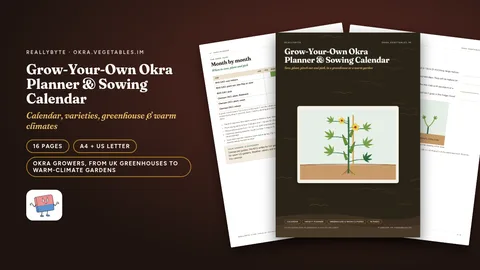
Grow-Your-Own Okra Planner & Sowing Calendar
Okra growers, from UK greenhouses to warm-climate gardens
A UK greenhouse calendar from the RHS and South Carolina planting dates from Clemson Extension side by side, a variety planner, a sowing tracker, a greenhouse and container plan, a spacing grid, weekly jobs, a ratooning page for warm climates, a watering and feeding log and a season review.
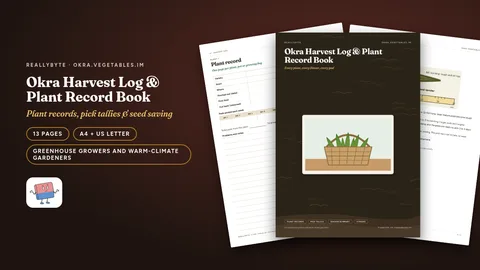
Okra Harvest Log & Plant Record Book
Greenhouse growers and warm-climate gardeners
Record every plant: variety, sowing and planting dates, first flowers, first pods, pinching out, pick-by-pick pod counts and weights, a pod-size check, a seed-saving page and a season summary for next year.
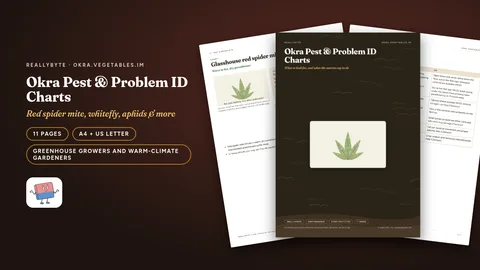
Okra Pest & Problem ID Charts
Greenhouse growers and warm-climate gardeners
Clear wall charts for glasshouse red spider mite, glasshouse whitefly, aphids and ants, stink bugs and corn earworm, pod rot and root problems, and powdery mildew, with what the RHS and US extension services say to look for and do. No chemicals.
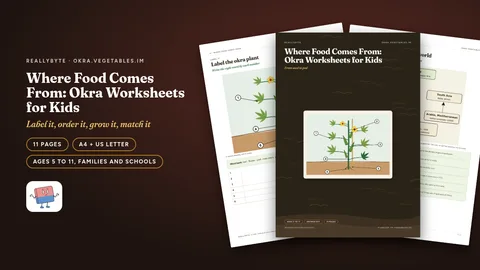
Where Food Comes From: Okra Worksheets for Kids
Ages 5 to 11, families and schools
Label an okra plant, follow okra from seed to pod, a grow-it diary, an okra true-or-false quiz, a where-in-the-world names match, a word search and a certificate, with an answer key.
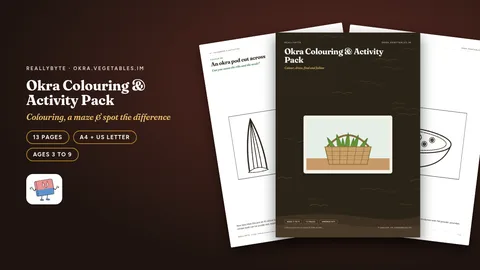
Okra Colouring & Activity Pack
Ages 3 to 9
Colouring pages of the okra plant, its big yellow flower, a pod cut across to show the seeds, harvest day and a pot of gumbo, plus a maze, spot-the-difference and design-your-own-pod pages.
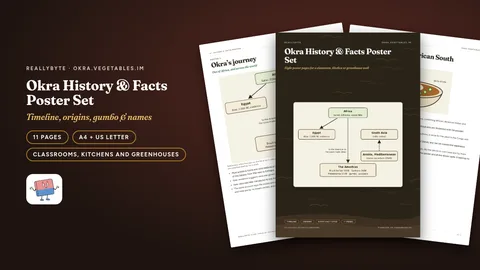
Okra History & Facts Poster Set
Classrooms, kitchens and greenhouses
Poster pages: the okra timeline from Kew’s 2,000 BC Egypt evidence to 1806, where okra came from (and where the sources disagree), okra across Africa, South Asia and the American South, gumbo and okra’s many names, parts of the plant and the pod.
 Best value
The Complete Okra Printables Bundle
All six packs plus a bundle guide, A4 and US Letter, in one download. $12.99 instead of $26.44 bought separately.